

SUMMARY
This article explains what CNC machining is, how it works, and why it remains the preferred manufacturing method for precision parts across industries in the UAE. It covers common materials, typical applications, and what businesses should know before sourcing a CNC machining partner in the region.
What CNC Machining Actually Means
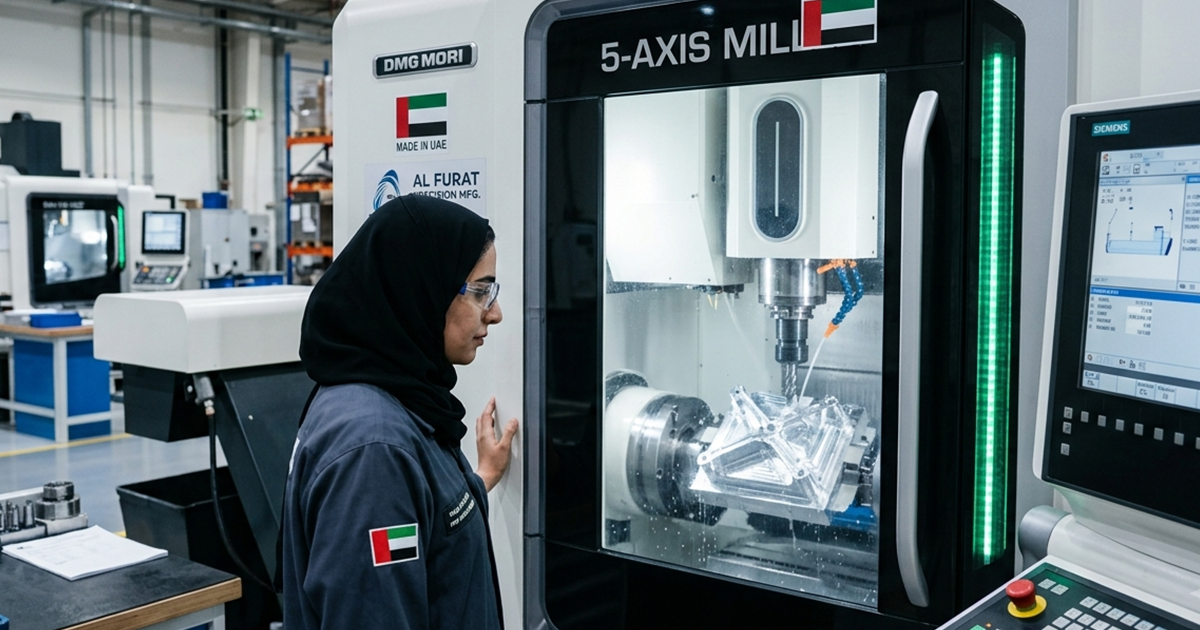
CNC stands for Computer Numerical Control, a manufacturing process in which pre-programmed software directs the movement of machine tools to cut, shape, or drill material with extremely high precision. Unlike manual machining, where a human operator physically guides cutting tools, CNC machines follow precise digital instructions, allowing the same part to be reproduced thousands of times with virtually no variation.
This precision and repeatability are exactly why CNC machining has become the standard manufacturing method for industries that cannot tolerate inconsistency, such as oil and gas, aerospace, defense, automotive, and industrial equipment, among others. A part that’s off by even a fraction of a millimeter can cause failure in critical machinery, which makes CNC machining’s accuracy a non-negotiable requirement rather than a convenience.
How the CNC Machining Process Works
The process generally follows a consistent sequence, regardless of what’s being produced:
- Design. A part begins as a CAD (Computer-Aided Design) file, created either by the client’s engineering team or by the manufacturer, in accordance with the client’s specifications.
- Programming. The CAD file is converted into machine instructions, a set of precise coordinates and tool paths the CNC machine will follow.
- Material setup. Raw material, typically metal stock such as aluminum, steel, or specialty alloys, is secured into the machine.
- Machining. The CNC machine executes the programmed instructions, cutting, drilling, or milling the material into the final shape.
- Quality inspection. Finished parts are measured against the original design specifications to confirm dimensional accuracy before delivery.
Common Materials Used in CNC Machining
- Aluminum — lightweight and corrosion-resistant, commonly used across general industrial applications
- Stainless steel — valued for strength and resistance to harsh environments, frequently used in oil and gas components
- Carbon steel — a cost-effective option for parts requiring high strength without extreme corrosion resistance
- Specialty alloys — selected for applications with specific performance requirements, such as high-temperature resistance
Industries That Rely on CNC Machining in the UAE
The UAE’s position as a regional industrial and energy hub means CNC machining demand spans several critical sectors:
- Oil and gas — custom components, replacement parts, and equipment used in extraction and processing operations
- Aerospace and defense — precision components where tolerances are measured in fractions of a millimeter
- Automotive — prototype and production parts for vehicle manufacturing and aftermarket components
- Industrial equipment — custom machine parts for manufacturing lines across multiple sectors
Why Precision Matters More Than Most Buyers Realize
A common misconception is that “close enough” tolerances are acceptable for non-critical parts. In practice, even minor dimensional inconsistencies can cause downstream problems, such as parts that don’t fit assemblies correctly, increased wear on connected components, or outright equipment failure in demanding environments like oil and gas operations. This is why reputable CNC machining providers operate under strict quality control processes and quality certifications that verify consistent precision across every batch produced, not just the first sample.
What to Look for in a CNC Machining Partner
- Quality certifications, such as ISO 9001, which confirm a documented and consistently followed quality management process
- Experience with your specific material requirements, since not every shop has equal expertise across aluminum, steel, and specialty alloys
- Turnaround capability for both prototypes and production runs, since needs often shift from a single prototype to a larger production order
- Clear quality inspection reporting, so every delivered batch comes with documented proof of dimensional accuracy
Frequently Asked Questions
What is the difference between CNC machining and manual machining?
CNC machining uses computer-controlled instructions to guide cutting tools with high precision and repeatability, while manual machining relies on a human operator physically controlling the tools, introducing greater variability between parts.
What tolerances can CNC machining achieve?
Modern CNC machining can typically achieve tolerances within a few thousandths of an inch (or fractions of a millimeter), though exact achievable tolerance depends on the material, part geometry, and specific machine capabilities.
Can CNC machining handle both prototypes and full production runs?
Yes, CNC machining is well-suited to both single-prototype parts and larger production volumes, since the same digital program can be used to produce one part or thousands with consistent accuracy.
Why is CNC machining important for the oil and gas industry specifically?
Oil and gas equipment often operates under extreme pressure, temperature, and corrosive conditions, making dimensional precision and material reliability critical to safe and effective operation, exactly what CNC machining is built to deliver consistently.
CNC machining remains the backbone of precision manufacturing across the UAE’s industrial sectors, and choosing a partner with proven quality processes is what separates parts that perform reliably from parts that create problems down the line.