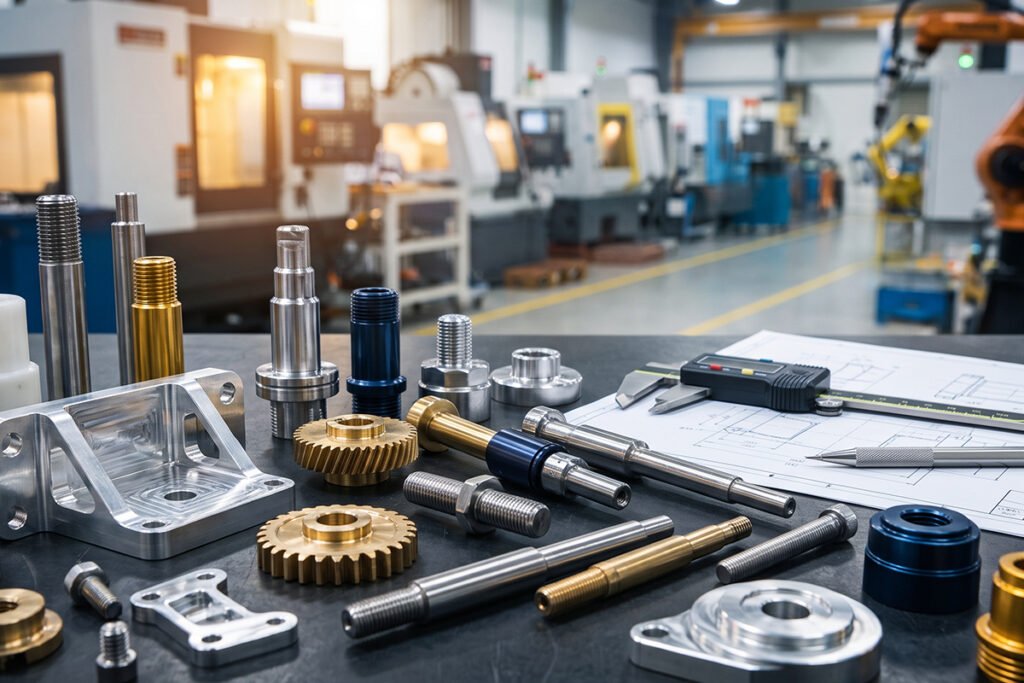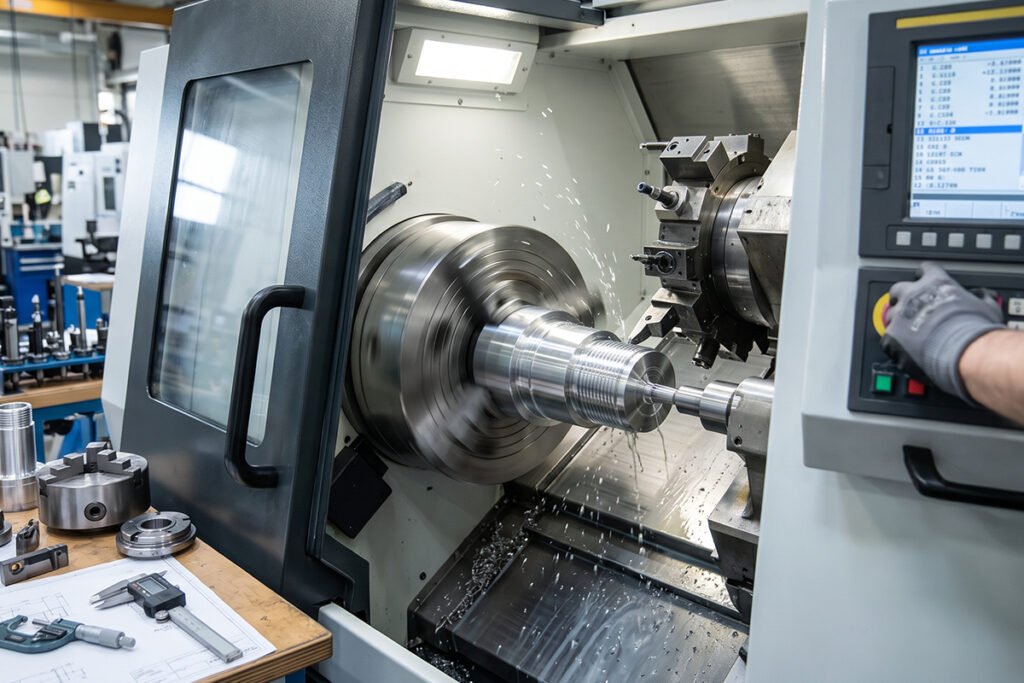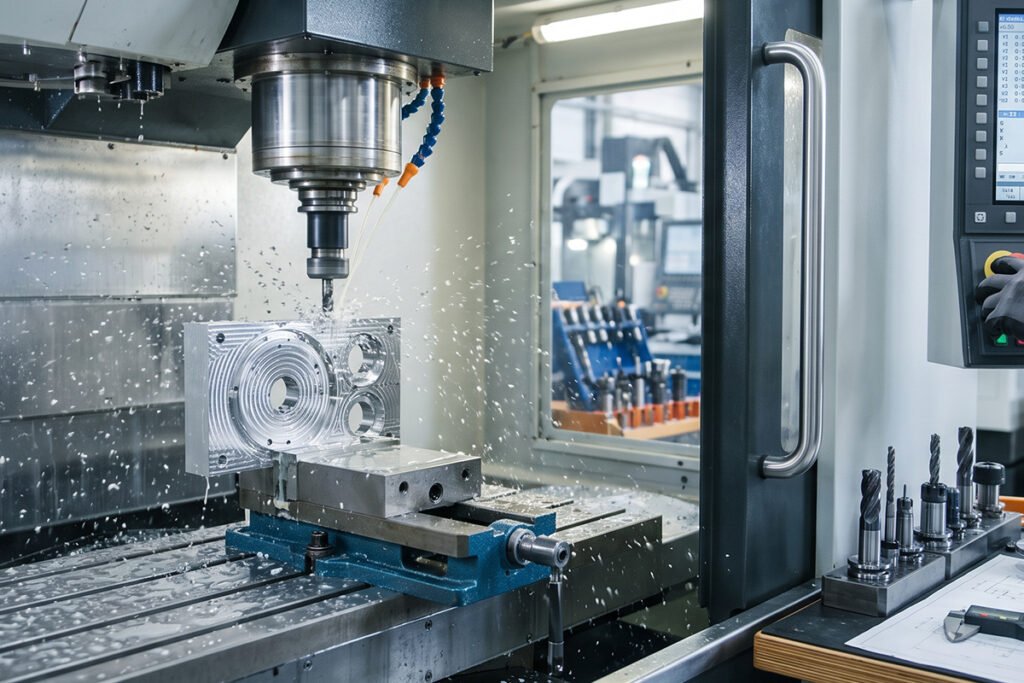

The price of a CNC-machined part comes down to five things: the material, the time the part spends on the machine, how tight the tolerances are, what happens after machining, and how many parts you order. Change any one of them and the quote moves.
This guide explains each factor so you can read a quote with confidence and see where a small drawing change would cut the price. It comes from the quoting desk at Genesis MFG, an ISO 9001 and API Spec Q1 certified machine shop in Hamriyah Free Zone, Sharjah.
We don’t publish a price list because two parts that look alike can cost very different amounts. What we can show you is how a quote is built.
What goes into a CNC machining quote
Most quotes for custom precision machined parts are built from six elements:
| Cost element | What it covers | What makes it go up |
|---|---|---|
| Material | Bar, plate or forging, plus allowance for clamping and cutting | Premium grades, large stock sizes, hard-to-find sizes |
| Programming | Writing the CNC program and setup sheet | Complex 3D surfaces, many features |
| Setup | Fixturing, loading tools, proving the first part | Each extra orientation the part must be clamped in |
| Machining time | The time the part is actually being cut | Hard materials, deep pockets, tight tolerances, fine finishes |
| Secondary operations | Heat treatment, coating, grinding, welding, marking | Every extra process on the drawing |
| Inspection and documents | Dimensional checks, reports, material certificates | Full inspection reports, certified paperwork |
Packaging and delivery are added on top, but for local deliveries across the UAE, they are usually a small share of the total.
The split between these elements depends on the job. On a simple bracket in aluminium, material and machining time dominate. On a one-off shaft in duplex stainless with a material certificate and full inspection report, programming, setup and documentation can outweigh the cutting itself.
Why quantity changes the unit price so much
Programming and setup are paid once per batch, then shared across every part in it. That is why a single prototype costs far more per piece than a production run of the same part.
Take a part that needs 3 hours of programming and setup and 20 minutes of machining per piece (illustrative figures):
| Quantity | Programming and setup per part | Machining per part | Total machine time per part |
|---|---|---|---|
| 1 | 3.00 h | 0.33 h | 3.33 h |
| 10 | 0.30 h | 0.33 h | 0.63 h |
| 50 | 0.06 h | 0.33 h | 0.39 h |
| 100 | 0.03 h | 0.33 h | 0.36 h |
In this example, one part costs about nine times more machine time than each part in a batch of 100. Two practical lessons follow:
• Order spares in the same batch. If you know you’ll need replacements next year, adding them now costs far less than a second setup later.
• Repeat orders are cheaper. Once a part is programmed and proven, the program is reused, so the next batch skips most of the programming cost.
CNC is still the right process for one-offs. Because the part is made from a program rather than a mould or die, there is no tooling cost to recover, which is why CNC suits prototypes and small batches. Small and large batch production goes further on choosing batch sizes.
Seven things that push the price up, and what to do about each
1. Material grade
Material affects price twice: the cost of the stock, and how fast it can be cut. Aluminium and free-machining brass cut quickly. Stainless steel, duplex, titanium and Inconel cut more slowly and wear tools faster, so the same part can take several times longer.
What to do: specify the grade the application actually needs, not the most premium one available. If you’re unsure, our engineers can suggest an alternative based on load, temperature, and corrosion. Our CNC machining materials guide compares the common options.
2. Geometry and number of setups
Deep, narrow pockets need long, slender tools that must cut gently. Thin walls vibrate and need light passes. Sharp internal corners need small tools. Features on many faces mean the part is re-clamped several times, and every re-clamp is another setup.
What to do: allow generous internal corner radii, avoid very deep narrow pockets where you can, and group features on as few faces as possible. For complex parts, 5-axis machining can finish the part in one or two setups, which often lowers the total price even though the machine rate is higher.
3. Tolerances
Tight tolerances slow the cutting, add inspection time, and raise the chance of rejected parts. Genesis MFG can hold down to ±0.001 mm, but a part that only needs that on one bore shouldn’t carry it on every dimension.
What to do: put tight tolerances only on functional features (fits, bores, sealing faces) and apply a general tolerance standard, such as ISO 2768-m, to everything else. CNC machining tolerances explained shows how to decide.
4. Surface finish
A standard as-machined finish (around Ra 3.2 µm) is the cheapest. Each finer step needs extra finishing passes, and very fine or polished finishes may need a separate operation.
What to do: call out fine finishes only on surfaces that need them, such as seal faces and bearing seats. Our guide to surface roughness (Ra) explains which finish suits which job.
5. Secondary operations
Heat treatment, plating, anodising, welding and assembly each add handling and, often, an outside process with its own lead time.
What to do: list every secondary operation on the RFQ so the quote is complete from the start. See coatings for machined parts in Gulf conditions for help choosing a finish.
6. Certification and documentation
Material certificates, first article inspection reports, full dimensional reports, and oil and gas documentation packs all take inspection time and paperwork. They are essential for pressure-containing or safety-critical parts, and unnecessary for a general bracket.
What to do: say exactly which documents you need when you ask for the quote, so nothing is added later.
7. Lead time
A rush order may mean rescheduling other jobs or running extra shifts. How CNC machining lead times work explains what shortens a lead time without a rush premium.
For a longer list of design changes that reduce cost, read how to reduce the cost of custom precision manufacturing.
Local or imported: the costs that aren’t on the quote
An overseas quote can look cheaper on unit price and still cost more once it arrives. Freight, customs clearance, import duties, and agent fees all add up. So does the wait: if a plant is down while a replacement part is in transit, a day of lost production can cost more than the part.
Machining locally in Sharjah removes most of those costs and puts the part within a short drive of Dubai and the northern emirates. When you compare quotes, compare the delivered cost and the date the part will be in your hands, not just the unit price.
How to get an accurate quote quickly
The more complete the request, the faster and tighter the price. Send:
• a 3D model (STEP or IGES) and a 2D drawing (PDF or DWG) with tolerances
• the material grade
• the quantity now, plus any expected repeat orders
• surface finish, coatings and heat treatment
• the certificates and inspection reports you need
Our CNC machining RFQ checklist covers each item in detail. With a complete request, Genesis MFG replies with a price and lead time within 24–48 hours.
Frequently asked questions
What is the hourly rate for CNC machining in the UAE? Rates vary with the machine. A large 5-axis machining centre costs more per hour than a small 3-axis mill or lathe. The hourly rate alone says little, though: a faster machine with fewer setups can produce a cheaper part. Compare total part price and delivery date across quotes instead.
Why does one prototype cost so much more than the production price? Programming and setup are paid once, whatever the quantity. On a single part, that one-off cost has nothing to be shared with.
Can you quote from a sample if I don’t have a drawing? Yes. We can reverse-engineer a part from a sample, then quote and machine new ones to match or improve on the original.
Is CNC milling or CNC turning cheaper? For round parts such as shafts, bushings, and pins, turning is usually faster and cheaper. Prismatic parts with pockets and faces suit milling. Many parts need both. See our CNC milling and CNC turning services.
Get a price for your part.
Send your drawing, CAD file, or sample to Genesis MFG in Hamriyah Free Zone, Sharjah. We’ll reply with a price and lead time within 24–48 hours, and point out any changes that would bring the cost down.