
A gasket is the cheapest component in a flanged joint and the one most likely to shut a plant down. Most gasket failures trace back to selection, not manufacturing: the wrong material for the medium, the wrong type for the flange, or a “close enough” substitute fitted during a night shift.
This guide covers the main gasket types, the materials they are made from, how to match them to pressure, temperature, and media, and the questions to answer before ordering a custom gasket. It is written for maintenance engineers, buyers, and contractors in the UAE’s oil and gas, water, power, and process industries.
Three questions that decide the gasket
Before type or material, establish:
- What is being sealed? Hydrocarbons, steam, water, acids, gases, food products. Chemical compatibility rules out most options immediately.
- At what temperature and pressure? Continuous operating values and excursions. Temperature limits the material; pressure and flange class limit the type.
- What is the flange? Raised face, flat face, ring-type joint, tongue and groove; flange class; flange material and condition. The gasket must suit the joint it sits in.
Engineers use the “TEMP” shorthand: Temperature, Environment (media), Mechanical (pressure, bolt load, vibration), Physical (flange type and condition).
Gasket types
Sheet (soft cut) gaskets
Cut from sheet material: compressed non-asbestos fibre (CNAF), rubber, PTFE, graphite or cork. The most common and least expensive type, used in low to moderate pressure flanges (typically up to Class 300) and general plant piping. Custom shapes are easily cut by CNC knife, waterjet, or laser, which is how most custom gaskets are made.
Use for: water, air, low-pressure steam, oils, general chemicals, equipment covers and housings.
Spiral wound gaskets
Alternating windings of a V-shaped metal strip (usually 304, 316L, or Monel) and a soft filler (graphite or PTFE), often with inner and outer rings. Made to ASME B16.20, they handle high pressure and temperature and recover well under thermal cycling. The standard choice for raised-face flanges in refineries, gas plants, and power stations.
Use for: hydrocarbons, steam, high-temperature process lines, Class 150 to 2500.
Ring-type joint (RTJ) gaskets
Solid metal rings, oval (R) or octagonal (R, RX) or BX profiles, seated in a machined groove in the flange. Metal-to-metal sealing for the highest pressures, defined in ASME B16.20 and API 6A. Materials range from soft iron and low-carbon steel to 316, Inconel, and duplex for sour service.
Use for: wellheads, Christmas trees, high-pressure pipelines, API 6A equipment.
Kammprofile (grooved metal) gaskets
A serrated metal core with a soft facing layer of graphite or PTFE. Combines the strength of a metal gasket with the sealability of a soft one, and tolerates imperfect flanges better than spiral wound. Increasingly used as a spiral wound replacement in heat exchangers.
Use for: heat exchangers, large-diameter flanges, damaged flange faces, high-cycle services.
Metal-jacketed gaskets
A soft filler enclosed in a thin metal jacket. Traditional for heat exchanger shells and covers where a custom shape with pass bars is needed.
O-rings and moulded seals
Elastomeric rings for grooves, static and dynamic. Selected by elastomer, hardness, and size to standard (AS568, ISO 3601).
Metal shims and spacers
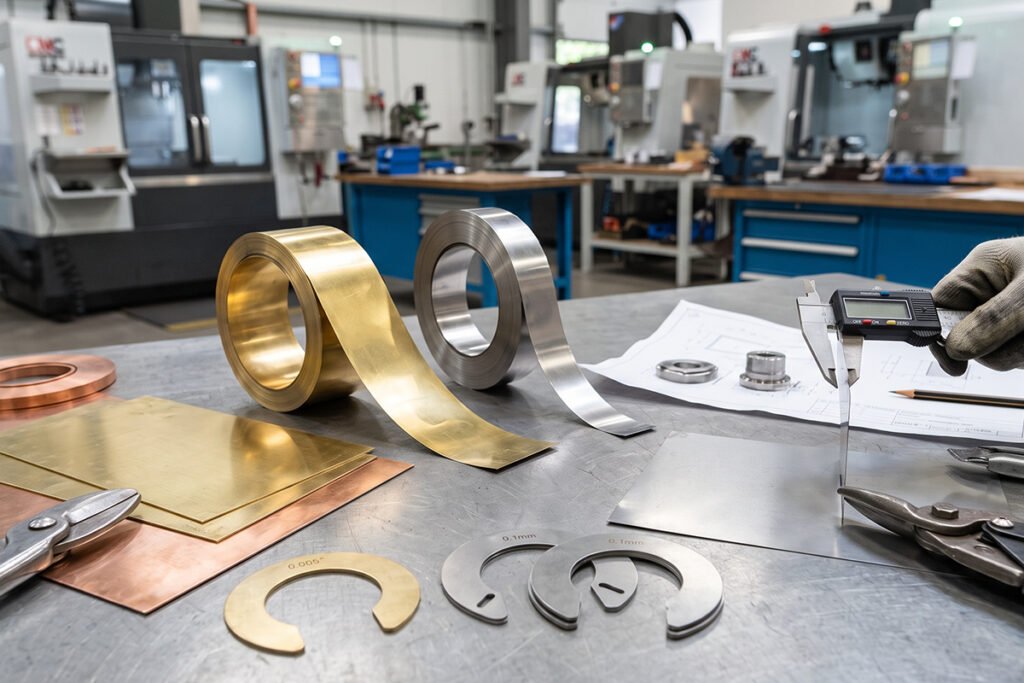
Not sealing components, but often ordered with gaskets: precision-cut metal shims to set clearances, alignment, and preload in pumps, gearboxes, and rotating equipment. Our custom gasket and metal shim service produces both from the same drawings.
Gasket materials
Material Typical max. temp Strengths Limits
Nitrile rubber (NBR) ~100 °C Oils, fuels, water; cheap Not for steam, acids, ozone
EPDM ~150 °C Water, steam, weathering, some chemicals Not for oils or hydrocarbons
Viton / FKM ~200 °C Fuels, hydrocarbons, many chemicals Cost; not for ketones or steam
Silicone ~230 °C Food, pharma, wide temperature range Poor with oils and fuels
Compressed non-asbestos fibre (CNAF) ~250–400 °C by grade General-purpose, economical Media-dependent; check grade
PTFE (virgin, filled, expanded) ~260 °C Near-universal chemical resistance, food grade Cold flow; pressure limits; expanded grades best
Flexible graphite ~450 °C (higher inert) Steam, hydrocarbons, high temperature, sealability Oxidation in air at high temp; strong oxidisers
Mica ~1,000 °C Extreme heat, exhaust Sealability lower; use with metal reinforcement
304 / 316L stainless High Spiral wound windings, RTJ, Kammprofile cores Chloride stress corrosion for 304
Monel, Inconel, duplex High Sour service, seawater, corrosive media Cost, lead time
Matching gasket to service: quick rules
- Water, air, low-pressure utilities: CNAF or rubber sheet gasket.
- Hydrocarbons at moderate pressure and temperature: CNAF (aramid/NBR grade), graphite sheet, or spiral wound with graphite filler above Class 300.
- Steam: graphite sheet at low pressure, spiral wound graphite above; never rubber.
- Acids, solvents, aggressive chemicals: PTFE (expanded PTFE for uneven flanges) or spiral wound with PTFE filler.
- High temperature (above 400 °C): spiral wound or Kammprofile with graphite, or mica for exhaust; metal RTJ where the flange allows.
- Sour service (H2S): materials to NACE MR0175 / ISO 15156, typically 316L, Monel or Inconel windings and rings; specify sour service at RFQ.
- Seawater and desalination: 316L is marginal; super duplex, Monel, or non-metallic PTFE/EPDM depending on the joint.
- Food and pharma: FDA-compliant silicone, EPDM, or PTFE.
When two options fit, choose the one that tolerates the real condition of your flanges. A perfect gasket on a pitted flange leaks; an expanded PTFE or Kammprofile gasket on the same flange often does not.
Why gaskets fail
- Wrong material for the medium, the most common cause
- Insufficient or uneven bolt load: no torque procedure, wrong bolt lubricant, or bolts tightened in the wrong sequence
- Thermal cycling with a gasket that cannot recover, such as rubber in a steam line
- Flange damage: radial scratches across the sealing face, corrosion, warping
- Over-compression crushing a soft gasket, or under-compression leaving it unseated
- Wrong thickness: thicker is not better; the thinnest gasket that accommodates flange irregularities seals best
- Storage: rubber and CNAF degrade with heat, UV, and age; graphite and PTFE do not
Standard versus custom gaskets
Standard flange gaskets to ASME B16.20 and B16.21 are stock items for common sizes and classes. Custom gaskets are needed for:
- Non-standard or legacy equipment (covers, manways, heat exchanger shells, compressors)
- Obsolete OEM gaskets with no drawing, which we reverse engineer from a worn sample
- Unusual materials or laminates
- Large diameters, segmented gaskets or multi-hole patterns
- Short runs with fast turnaround
Genesis-MFG cuts custom gaskets from any of the sheet materials above and manufactures metal shims and spacers to drawing or sample, with material certificates on request.
What to include in a gasket RFQ
- Drawing, sample or flange details (size, class, face type, standard)
- Media, temperature and pressure, including excursions
- Material preference or “recommend”
- Thickness
- Quantity and whether it is a one-off or recurring
- Certification needs: MTC, FDA, NACE, fire-safe (API 6FB / API 607)
Request a custom gasket quote. If the gasket is for oil and gas field equipment, our sourcing team can supply the associated flanges, fasteners, and spares in the same order.
FAQ
What are the main types of gaskets?
Sheet (soft cut), spiral wound, ring-type joint (RTJ), Kammprofile, metal-jacketed, and O-rings, plus custom-cut gaskets for non-standard equipment.
Which gasket material is best for high temperature?
Flexible graphite up to around 450 °C in air, spiral wound or Kammprofile with graphite for high-pressure steam and hydrocarbons, and mica or metal RTJ for extreme temperatures.
What is the difference between spiral wound and RTJ gaskets?
Spiral wound gaskets sit on a raised-face flange and seal through a metal-filler winding; RTJ gaskets are solid metal rings seated in a machined groove for very high pressures, common on wellheads and API 6A equipment.
Can PTFE gaskets be used with steam?
Generally no. PTFE cold-flows and loses seating stress under thermal cycling; graphite or spiral-wound graphite is the standard choice for steam.
How thick should a gasket be?
As thin as the flange condition allows. Thicker gaskets have more area exposed to pressure and creep more; 1.5–3 mm is typical for sheet gaskets.
Do you supply gaskets with material certificates?
Yes. Material test certificates and, where relevant, NACE or FDA compliance statements are provided on request.