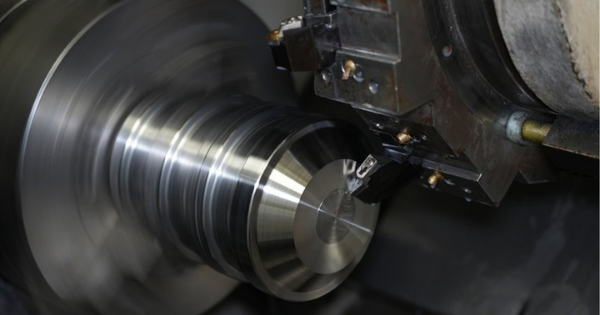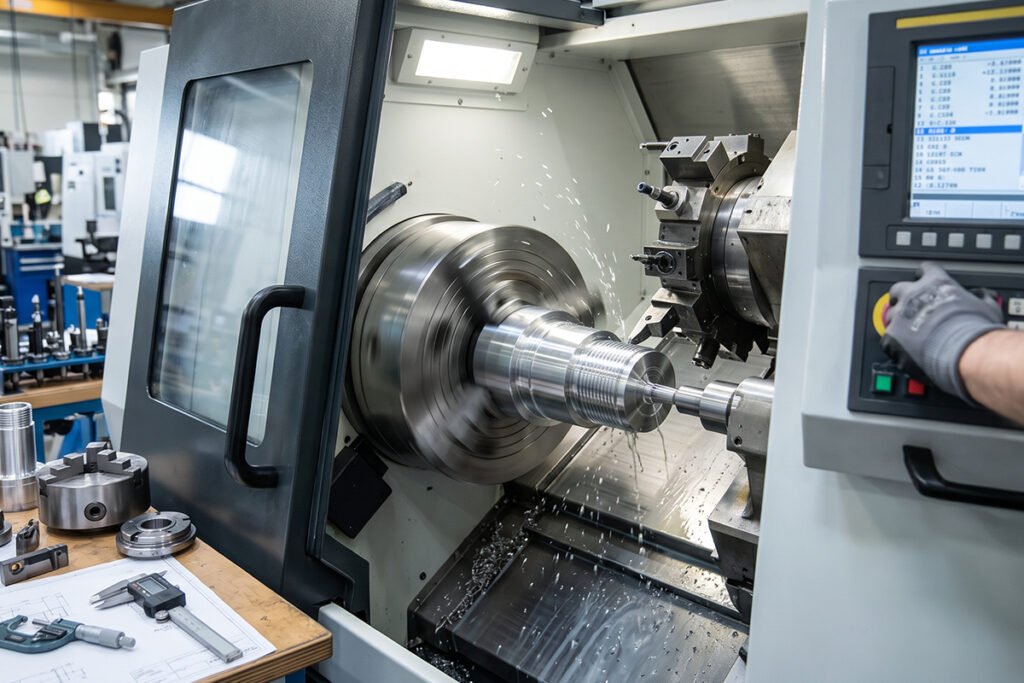

Roller burnishing is a cold-working finishing process. Hardened rollers press a machined metal surface smooth, giving a mirror-like finish in a single pass. No material is removed. The surface is reshaped, not cut. For hydraulic bores, valve seats and oil and gas components that must seal under pressure, it is one of the fastest and most cost-effective finishing methods available.
This guide covers how roller burnishing works, what it achieves, where it’s used and when it’s the wrong choice.
How Roller Burnishing Works
Every machined surface has microscopic peaks and valleys left by the cutting tool. Roller burnishing flattens them.
- Pre-machining: The part is turned, bored or reamed to a size slightly off the final dimension. The allowance is usually a few hundredths of a millimetre.
- Tool engagement: A burnishing tool with hardened, highly polished rollers is fed into the bore or along the outside diameter. The rollers are set at a slight angle in a cage around a tapered mandrel.
- Plastic deformation: As the tool rotates and feeds, the rollers apply pressure above the material’s yield strength. The peaks flow plastically into the valleys.
- Final surface: The result is a smooth, dense, work-hardened layer at the final size usually in seconds per part.
Roller burnishing runs on the same CNC lathe, machining centre or drill that did the pre-machining. It needs no separate grinding or honing setup.
Key Benefits of Roller Burnishing
Mirror surface finish in one pass.
Roller burnishing typically takes a turned surface of around Ra 2–4 µm down to Ra 0.05–0.2 µm. Grinding, honing or lapping usually need several operations to match that.
Higher surface hardness
Cold working hardens the surface layer. This improves wear resistance on sealing faces and sliding surfaces.
Longer fatigue life
Burnishing leaves compressive residual stress in the surface. This resists crack initiation, which matters for parts under cyclic pressure such as pump barrels and hydraulic cylinders.
Better sealing performance
A smooth, plateau-like surface reduces seal wear and leakage paths, especially for O-rings and lip seals in high-pressure service.
Lower cost and shorter cycle times
Burnishing produces no chips, needs no abrasives and runs on the existing machine. It often replaces a grinding or honing step which cuts handling, setup time and lead time.
Tight dimensional control
Size is controlled by the tool setting. Burnishing holds consistent tolerances from part to part across long production runs.
Common Applications
| Industry | Typical components |
| Oil and gas | Valve bodies and seats, pump barrels, plungers, seal bores, wellhead components |
| Hydraulics | Cylinder tubes and bores, piston rods, valve spools |
| Automotive | Brake cylinders, shock absorber tubes, crankshaft fillets, bearing journals |
| General engineering | Bushings, shafts, bearing seats, rollers |
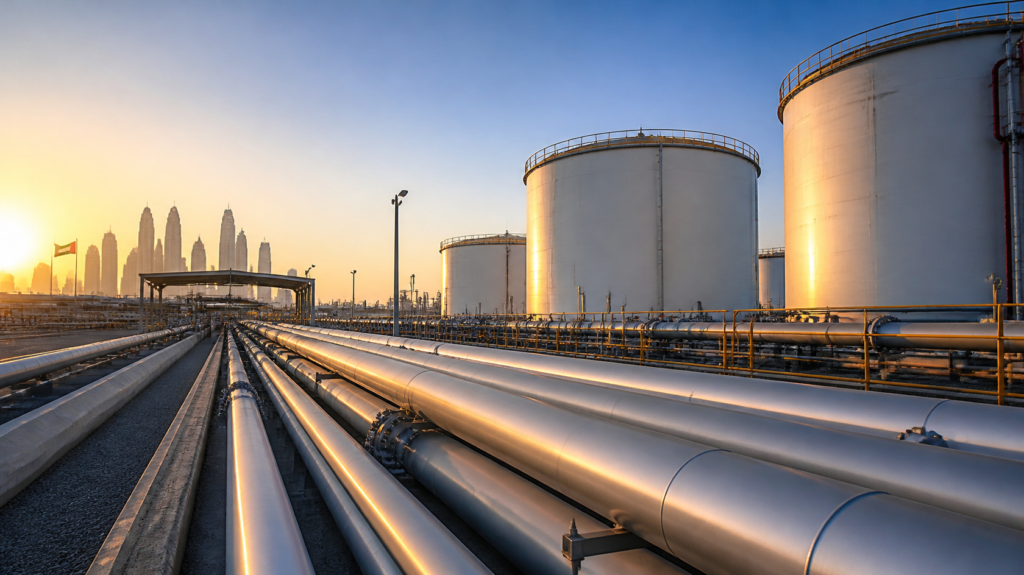
In oil and gas especially, roller burnishing is valued for seal bores. Those are surfaces where a poor finish means leaks, downtime and costly seal replacement.
Limitations of Roller Burnishing
Roller burnishing isn’t right for every part. Know its limits before you specify it.
• It won’t fix geometry. Burnishing improves finish and only slightly refines size. It doesn’t correct roundness, straightness or taper errors from pre-machining. Those must be right before burnishing.
• Material hardness limits. It works best on ductile metals up to about 40–45 HRC. Very hard or brittle materials don’t deform plastically enough.
• Thin walls can distort. Burnishing pressure can deflect thin-walled tubes or small, delicate parts.
• Interrupted surfaces. Cross holes, keyways and slots can mark the rollers or leave an uneven finish at the edges.
• Pre-machining discipline. The pre-machined size and finish must sit inside a narrow window. Too much allowance overloads the tool, and too little leaves marks.
Roller Burnishing vs Honing vs Grinding
| Roller burnishing | Honing | Grinding | |
| Removes material | No | Yes | Yes |
| Typical finish | Ra 0.05–0.2 µm | Ra 0.1–0.4 µm | Ra 0.2–0.8 µm |
| Corrects geometry | No | Yes | Yes |
| Adds compressive stress | Yes | No | No |
| Cycle time | Seconds | Minutes | Minutes |
| Extra machine needed | No | Usually | Yes |
If the part needs geometry correction, hone or grind first. If geometry is already right and you need finish, hardness and fatigue life, roller burnishing is usually faster and cheaper.
Frequently Asked Questions
Does roller burnishing remove material? No. It reshapes the surface by plastic deformation. The diameter changes only slightly as peaks are flattened.
What surface finish can roller burnishing achieve? Typically Ra 0.05–0.2 µm, depending on the material, the pre-machined finish and the tool.
Can stainless steel be roller burnished? Yes. Austenitic and duplex stainless steels burnish well and work-harden noticeably which improves wear resistance.
Is roller burnishing the same as ball burnishing? They work the same way. Ball burnishing uses a single hardened ball and suits small or complex profiles. Roller burnishing uses several rollers and is faster on bores and shafts.
Need Precision-Finished Components in the UAE?
Genesis-MFG is an ISO 9001-certified machine shop in Hamriyah Free Zone, Sharjah. We make custom and replacement components for oil and gas and other industries. To discuss a part that needs a high-integrity sealing surface, see our custom precision manufacturing services or contact our team.